A career in virus research
Kay, whose full name is Kathleen but who is known as Kay, began her career as a teacher but found classroom management challenging. After leaving teaching, she noticed an advertisement for a technician position at the Common Cold Unit (CCU) near Salisbury and successfully applied. Her husband, who worked at Porton Down, had told her about the Unit and this connection encouraged her to apply.
Kay joined the Common Cold Unit in 1970 and remained there until her retirement in 1986. What began as a technician’s post evolved into a long and fulfilling scientific career. Initially, she worked closely with the volunteers who took part in the Unit’s controlled infection studies. Her early tasks included collecting nasal washings and handling blood samples, carefully preventing contamination. She described visiting the volunteers’ accommodation blocks to collect samples directly from their rooms, explaining how volunteers would tilt their heads back for saline drops and then expel the fluid into Petri dishes.
Over time, Kay progressed through the ranks, becoming a Research Officer, then undertaking a degree with the Open University, which led to a promotion to Senior Research Officer. She later became a tutor for the Open University, teaching foundation science courses and even hosting student meetings in one of the Common Cold Unit’s buildings.
Her scientific work expanded beyond technical duties to include independent research and published papers. Kay co-authored studies, including one from 1985–1987 on humoral immunity and respiratory coronaviruses, working alongside Dr. David Tyrrell, her supervisor and the Unit’s head, as well as other collaborators such as R.J. Shaw and Penny Fitzharris. She noted with interest that her coronavirus research from the 1980s had gained renewed relevance during the COVID-19 pandemic decades later. Another of her projects explored atopy (allergy), discovering that individuals with allergic tendencies experienced more severe symptoms when infected with cold viruses.
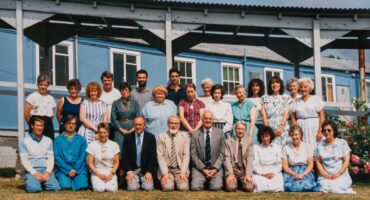
Kay spoke with affection about the atmosphere at the Unit, describing the 18 years she spent there as “the best time of my life.” She remembered the staff as a “friendly, family-like group,” with daily routines that included shared coffee breaks and lunches in the communal dining hall. She mentioned colleagues such as Kathy, Audrey and Jane, some of whom she still occasionally met for coffee.
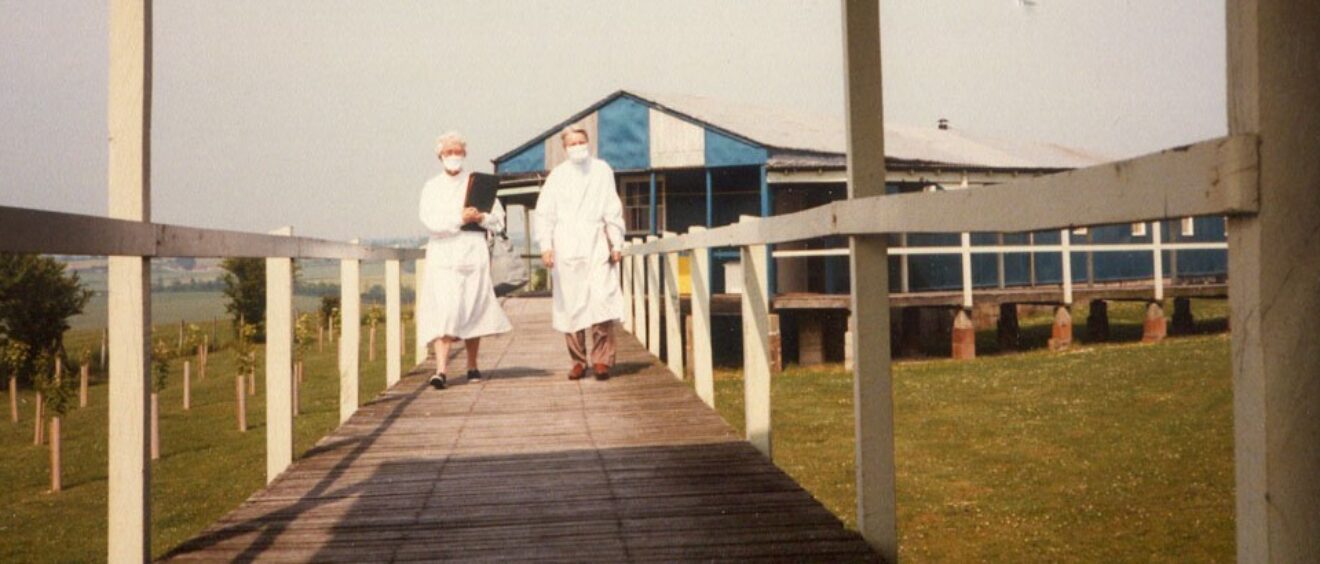
She recalled the layout of the site, situated on an exposed hill but connected by covered walkways, with around a dozen buildings housing laboratories, offices and volunteer quarters. Staff and volunteers followed strict isolation protocols to prevent viral spread, with researchers donning white lab coats, gloves and masks. Despite these precautions, some volunteers occasionally broke the rules and ventured into town or the local pub.
Kay also recounted the Unit’s international reputation: visitors from abroad, including a memorable visit from Russian scientists who were surprised to find “no guards” at what they assumed was a secret facility. She noted that the CCU contributed a great deal of valuable scientific knowledge, including the first isolation and growth of a cold virus, as well as studies that influenced drug development, virus behaviour and immunology.
Her work extended to experiments with influenza viruses grown in eggs, explaining how eggs were inoculated and incubated before harvesting the virus, linking this to the modern use of egg-based flu vaccines. She also described laboratory tools such as the ELISA reader, used for detecting antibodies in samples.
Reflecting on the later years, Kay emphasized how her background at the CCU helped her understand the science communicated during the COVID-19 pandemic. She recognized familiar concepts, such as isolation and infection control, from her own work decades earlier.
When asked about her favourite memories, Kay spoke not of the experiments or publications, but of the friendships and sense of purpose that defined her time there. For her, the Common Cold Unit was not just a workplace but a community, a place where curiosity, collaboration and kindness thrived.
Listen to Kay talking about her time at CCU: