Behind the trials: Everyday work of the Common Cold Unit
Pamela, better known as Kathy, began her journey at the Common Cold Unit in May 1955, just over sixteen years old. She recalls starting as an “apprentice lab technician” with the Medical Research Council, describing the small unit as “never very big” when she joined. Initially, her work involved assisting newer staff like Dr. Ferreira, who had recently come from Brazil and struggled with the local Wiltshire accent! Reflecting on those early days, she says, “You’re 16, you’re not very confident then. Anyway, we got on very well.”
As the unit grew under the leadership of Dr. David Tyrrell, Kathy’s responsibilities expanded. She began to coordinate the practical side of the trials, ensuring that volunteers’ samples were collected, stored, and tested. She explains:
“It was my job to arrange the practical side of the trials… make sure there were people to do all their jobs, make sure everything was ready on time.”
Alongside her work, she pursued evening classes in Salisbury, earning her laboratory qualifications and eventually completing a dissertation for her fellowship in virology. She reflects on her professional growth with pride, noting, “I can’t imagine doing anything else.”
Kathy described the evolution of laboratory techniques over her time at the CCU. Early work struggled with reproducing viral cultures, but by the 1960s, advances like diploid cell cultures and improved storage methods “made a big difference.” She remembered how even small discoveries could have major effects: “Somebody put the wrong amount of bicarbonate in… and we found, yes, now that that was good, as well, because suddenly things started to happen.” She also described the meticulous process of testing volunteers, using nose washings and tissue cultures to track viral growth and antibody responses.
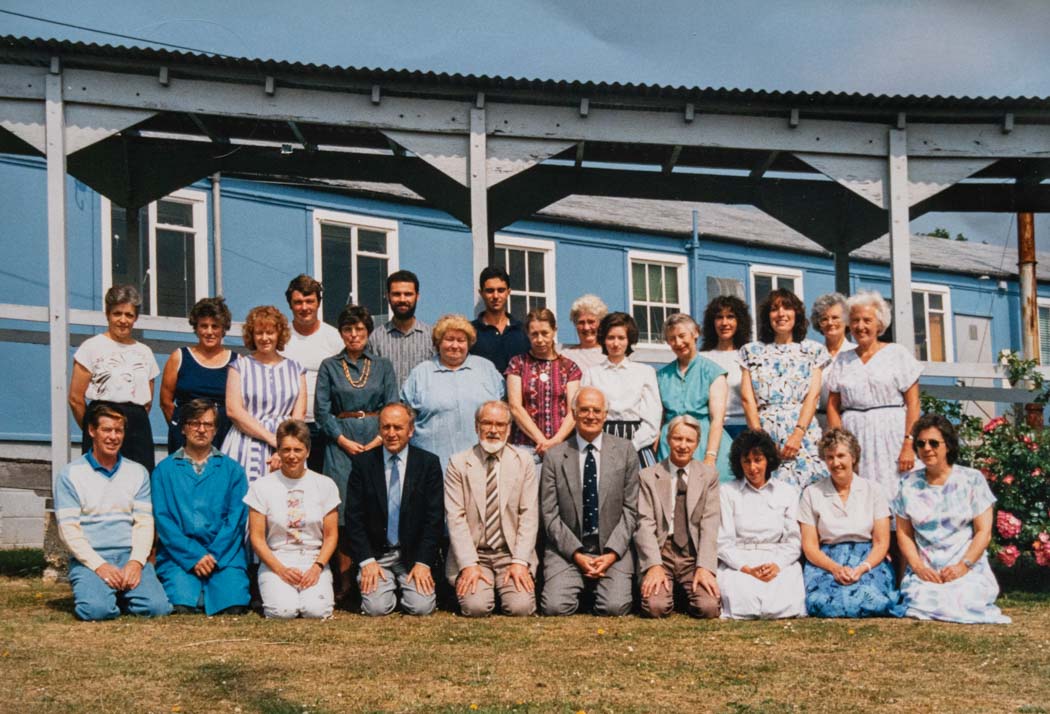
Despite the challenges, she cherished the camaraderie and collaborative spirit of the unit. “We were very, very happy, very happy sort of family,” she said, noting that she never felt unequal as a woman in the lab. Her work also brought her into contact with visiting scientists from around the world, giving her a global perspective on virology.
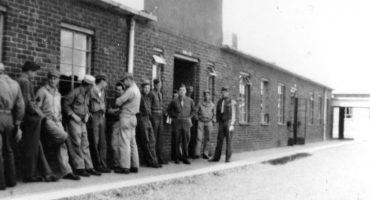
Kathy had fond memories of the CCU site itself: “Prefabricated buildings… connected by wooden slatted runways… so you really had to wear flat shoes or you would lose your heels.” Volunteers stayed in isolation huts and were well cared for, with meals delivered to their doors and activities to keep them occupied. She recalled the reunions that continued long after the unit’s closure in 1989: “We had a reunion every July, and quite a lot of the volunteers came to the very end.”
The closure of the unit was bittersweet. Kathy and a small remaining team spent a year carefully dismantling the lab and sending equipment to Northwick Park. “We were all pretty sad… we’d been such a good, good team together. And we felt that we’d achieved a lot.” On a personal note, she met her husband through the unit’s building projects, describing how Harvard Hospital became “part of both our lives for a long time.”
Looking back, Kathy’s reflections convey deep satisfaction with her career: “I can’t really say that I ever thought, ‘Oh, I’ve got to go to work in the morning!’ I enjoyed the work that I did there and the company of the people that I’ve worked with.” For her, the Common Cold Unit was not just a workplace but a formative chapter filled with scientific discovery, camaraderie, and lifelong connections.