Memories of the Old Manor Tunnels
This article is about a tunnel at the Old Manor Hospital, Salisbury is by Richard Avery and was compiled using his experiences of 23 years working at the Old Manor hospital from September 1963 to March 1986. He has spoken to several other staff who have worked in the hospital in the intervening years.
The Old Manor Hospital (formerly known as the Fisherton Asylum) is a psychiatric hospital that opened as a private asylum in the early 19th century, became incorporated in the National Health Service in 1950 and later became Fountain Way in 2003. When Fisherton Asylum first opened it was centred on a residence called Fisherton House and incorporated a number of associated buildings which were converted into wards; later purpose-built wards were added in the grounds. Neighbouring properties like Montague House, Llangarren and Pembroke Lodge (as of 2014 the Quaker Meeting House) were purchased up until the 1930s.
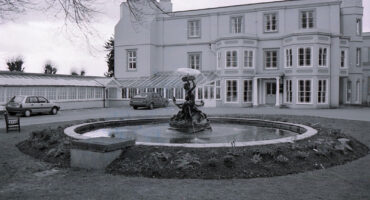
The tunnel is closely associated with the main building which has latterly been called Finch House (after a former proprietor of the hospital William Corbin Finch.) The tunnel runs in almost a straight line, in an east/ west orientation and a few yards to the south of Finch House. There are two short branches off the tunnel leading into Finch House. One to the rear of the building by a series of steps and another near the front of the building that lead into a cellar under the building. There is no evidence of a tunnel branch leading off to the south.
The Tunnel
The tunnel had two principal entrances. The eastern doorway is at the end of the sloping glass covered walkway to the south east of Finch House. The western entrance is now buried under newly constructed residential apartments about 150 yards to the west of the other entrance.
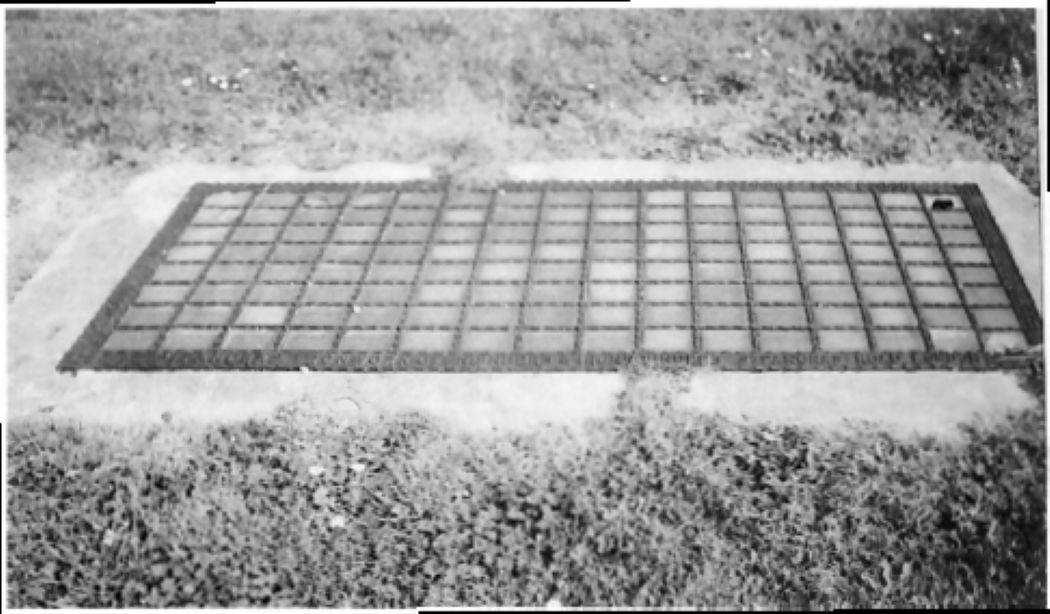
The tunnel is about 7 feet high and about 6 feet wide with a round arch profile and lined with white porcelain brick tiles. The ceiling is about 4 feet below ground level. The floor is well constructed with flat paving stones as can be seen in the pictures below. It is mostly straight, but the western end curves slightly northwards. Along its length there were, in 1963, skylights set at intervals into the ground to illuminate the passageway, although the tunnel also seemed to have non-functioning electric lights.
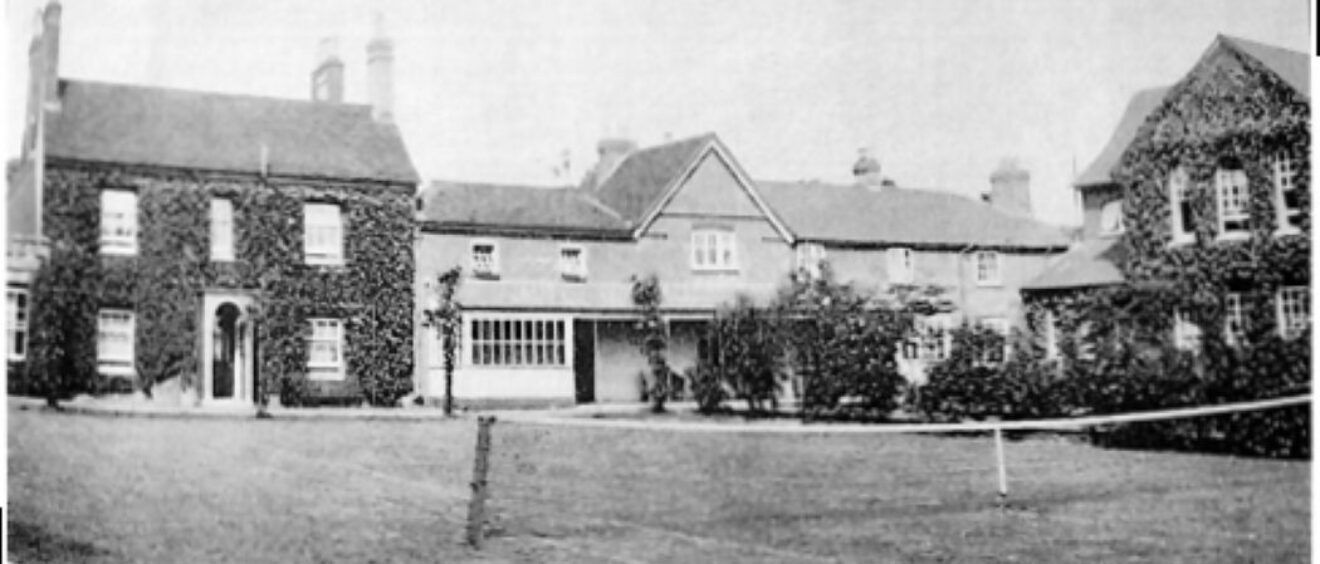
In the early 1960s the tunnel emerged at its western end into a passageway in Fonthill Villa, a ward that was demolished in 1964 to make space for the construction of Nightingale Ward. The tunnel was blocked up at that time. An old photograph of Fonthill Villa can be seen below.
About halfway along its length there is a set of about 10 steps leading up to the kitchen/service area. At the top of the steps was a locked door. Near the eastern entrance there was another short passageway leading into a cellar reportedly furnished with a table and chairs. The purpose of this room is unknown.
The age of the tunnel is not known but is assumed to be from the 19th century.
In the mid-nineteen sixties the hospital installed central heating to wards and offices and the tunnel was used in part to accommodate heating pipes. These are clearly visible in photographs.
The purpose of the tunnel
The purpose of the tunnel has been lost over time but there has been modern speculation attempting to fill this knowledge vacuum. There are four explanations popularly proposed for the use of the tunnel. This document will look at each of the suggestions, examine them in detail and consider how likely it is to be a valid purpose.
1. A local, long held idea is that the tunnel formed part of a bigger network that connected to the local railway station. The idea behind this theory is that it would be to bring patients to the asylum when they had arrived by train and then transfer them to the hospital through a tunnel to protect them from the public gaze or for security purposes, or both.
There are some issues with this theory that need some explanation:
How many inmates were admitted each year from a distance that required a train that and would justify the expense of a 310 yard tunnel? The distance from the existing tunnel to the main building of the station. (the nearest part of the Fisherton Asylum property was 220 yards.)
It is known that the Fisherton Asylum housed criminal lunatics prior to the opening of Broadmoor Hospital in 1863. After this time it is highly improbable that fewer criminal lunatics were admitted to Fisherton Asylum. This implies that security measures would have been less needed after this time, although there may have been a small number who may have been considered dangerous but had not committed a crime.
The Salisbury railway station that we know today opened in 1859 with a connection to London. This means that there were only about 4 years when criminal lunatics, who may have needed extra security, and may have arrived by train for admission.
How were inmates transported to the asylum before the railway? Would the owners of Fisherton Asylum have invested significant money in building a tunnel when the Salisbury Station was opened?
Now we need to examine the supposed tunnel. There is no physical evidence to date to confirm the existence of a tunnel between the Salisbury railway station and the asylum/hospital. Over the last 100 or so years new buildings have been built on the hospital site (eg: New Sarum and Sarum in 1923. The Fisherton Assessment Unit in about 1983) and there have been no reports of a tunnel being found.
A tunnel of such length would require possibly ventilation and illumination by skylights or electricity. No evidence of this is to be seen or has been found. The cost of building a tunnel of that length would be considerable, assuming the railway companies agreed to its construction under their buildings and tracks. There would be relatively little profit in it for them. It would be more logical and cheaper to build a shorter tunnel that emerged just inside the asylum property but there is no evidence of this either. There is also no evidence of a linking tunnel on railway property.
In late 2024 a tunnel at the railway station made local news when it was “discovered,” however this tunnel was already known to former employees at the station as an underground store. Additionally it was outside the ticket office and as far from the asylum as it could be. It would have required inmates to leave the station building. This position somewhat neutralises the idea that the t tunnel was built for public security and to protect inmates from public gaze.
2. Another popular theory for the tunnel’s use was as a way of separating male and female patients when they attended chapel in the asylum. Superficially this seems plausible but there are certain aspects of this idea that require explanation.
Firstly, as demonstrated in the diagram, the entrances to the tunnel were about 100 yards from the chapel and one exit/entrance was within a ward. It is difficult in practice to see how this system worked.
It must also be remembered that some male and female patients mixed socially at that time in the Ballroom for tea dances once a month.
Patients who may have been a risk to others would not have been permitted to go to the chapel, or if they did they would have been accompanied appropriately. Then as now the great majority of mentally ill patients were not dangerous.
There is a further question to be answered. If the tunnel was constructed for this purpose why did the owners of the asylum go to the trouble of building an expensive tunnel when a brick built passage way would have served the same purpose?
A similar suggestion for the tunnel has been offered with the variation that it was to protect staff when crossing the grounds. Possibly the same staff as those caring for inmates in the wards? Also, again the limitation and position of the entrance/exit is not practical. And as previously noted dangerous patients would not be permitted to roam in the open parts of the asylum.
3. The third suggestion proposed is a rather more mundane purpose; that it was simply a service tunnel built when Fisherton House was constructed and used for the delivery of goods and the entrance/exit to be used by staff employed by the owners of Fisherton House who may have been living in the buildings that later became Fonthill Villa.
This would explain the steps to the service area at the rear of the house and the room off the passage way near the front of the house which may have been manned by a senior servant who checked staff or deliveries as they came and went. This, like all the suggestions, is merely speculative but the configuration of the tunnel more closely matches this purpose than any of the others.
We have no clear historical evidence of the associated architecture at the front or the rear of Fisherton House, but it is not difficult to believe that the two entrances were at some point in the past rather more obscured from Fisherton House but accessible by tradesmen or staff. Service tunnels were widely used in mansions in the 17th and 18th centuries and there is little reason to deny Fisherton House this facility.

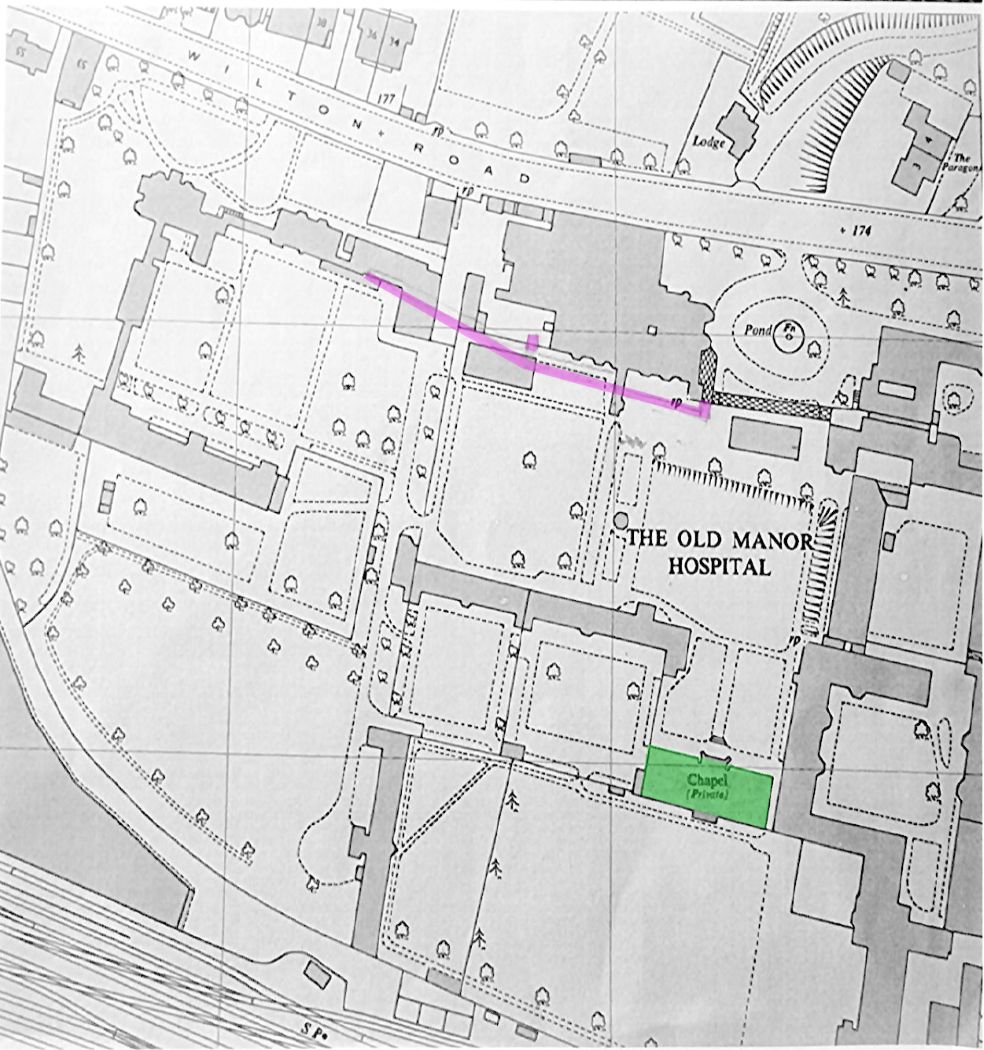
4. In addition to the urban myths dealing with the Old Manor tunnel there still exists a belief that there was/is a tunnel from the old Fisherton Asylum/Old Manor Hospital running under the Wilton Road to the north part of the then hospital campus. There is no physical evidence to substantiate this idea.
There have been two reasons suggested for this tunnel. One was for the transfer of patients to a ward from the main site to the northern site. The northern site contained two wards and staff accommodation in Montague House. Llangarren, which was purchased in 1923 and was opened as a ward for ladies to convalesce. Similarly Orchard House was built in the 1930s as a convalescent ward for ladies.
A further suggestion has been proposed that a tunnel was built from the main site to Llangarren so that visitors could enter discretely. This meant that visitors would have to enter the main site to enter Llangarren “discretely”. Both of the wards and Montague House had independent heating systems and any suggestion that pipes were laid under the road from the main site as part of the mid-nineteen sixties central heating scheme is entirely untrue. Large parts of what was the northern site have undergone building surveys. It is highly likely that if any tunnel existed it would have been found
A tunnel in a public place such as under the A36 would be shown on Ordnance Survey maps. No such tunnel is shown on any OS map
There is no evidence of a tunnel exit or entrance from the main site to the north part of the hospital.
Listen to Richard talking about the tunnels:
Richard Avery, Feb.2025
I am grateful to Tony Howe for the use of his photographs.